
We make custom springs for shelf pushers that move products towards the front of a display. We develop the spring around the goods, rail, available travel and pushing force your mechanism needs, using your drawing or sample.
Two shelf pusher layouts
We customise the spring around the available coil space, strip path and end attachments in your pusher. Example A shows a metal strip extending along the track towards the pusher plate. Example B shows a different layout with a transparent end section.
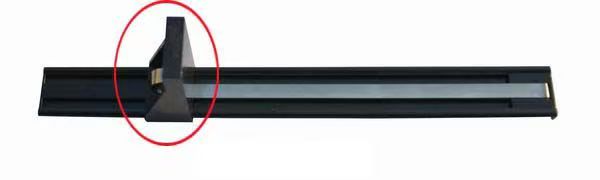
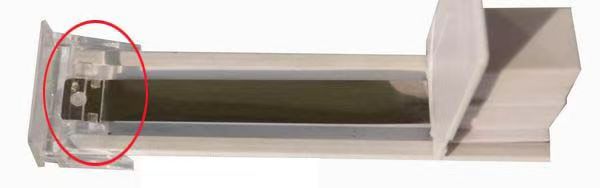
We customise the spring component to fit your pusher mechanism. These are application examples; the required force profile is defined from your goods, rail and working travel.
Match the push to the goods and rail
A fully loaded row and the last item may need different pushing forces. Pack shape, contact surfaces, dividers and rail friction affect the movement. The spring must provide enough push to advance the goods while keeping the force at the front suitable for the packaging and for product removal.
We work from the complete pusher arrangement when defining the spring. A rail sample, pusher plate drawing and representative pack dimensions help us check the spring space, strip path and end attachment together.
Set force targets along the travel
Give the usable stroke from a fully loaded row to the last item. Specify target force and the acceptable range at the start, middle and end, including the units. Tell us where goods tend to stick and how much force is acceptable at the front stop. These operating points let us define the force profile with you.
Constant or variable force?
Consider variable force springs when the target push changes with position, and constant force springs when approximately steady pull is needed over the working stroke. We compare your target force profile with the rail, pusher and goods before selecting the spring.
What to send for a quote
- Pack dimensions, mass and the number of items in a loaded row.
- Rail length, usable stroke, pusher geometry and divider arrangement.
- Force targets at defined positions, including the last item.
- Contact surfaces, friction information and shelf orientation.
- Coil space, strip exit direction and end attachment.
- Cleaning, moisture or temperature conditions, target duty and quantities.
Developing a spring from your sample
Send a rail and pusher sample or a drawing showing the installation. Include the intended goods, or their dimensions and weight, plus the target force at the key positions. We can use the sample to review the strip size, coil space and end connection, then agree the working stroke and force requirements for your project.
Send us your pusher requirements
Send the rail or mechanism drawing, pack dimensions and weight, required travel, and sample and production quantities. If force targets are not yet defined, describe how the loaded row and last item should move so we can help identify the operating points to check.